
Red Light Therapy at Home: What to Look for Before You Buy
REJUVITALIS BLOG — Category: Red Light Wellness | Read time: 9-11 min | SEO target: "red light wellness panel home buyer's guide"
Red light panels have crossed over from a niche wellness tool to a mainstream category, and the home panel market has exploded with it. Hundreds of options now exist at every price point, with specs that range from genuinely well-built to essentially decorative.
The problem: most buyers can't tell the difference. The marketing all sounds the same. Every brand claims to use the "right" wavelengths, the "highest" output, and the "most advanced" technology. Without a framework for evaluating what actually matters, you're essentially guessing with several hundred to several thousand dollars.
This guide gives you that framework. By the end, you'll know exactly what separates a well-built panel from one that just glows red and does very little else.
The red light panel market is full of underpowered, mis-specced, and overmarketed products. Knowing what to look for is the only protection you have.
First: What Is Red Light Actually Doing?
Red light devices use specific wavelengths of red and near-infrared light. This category of product is sometimes called photobiomodulation or low-level light therapy, and it's become one of the most popular categories in the at-home wellness space.
Red light at 660nm reaches the surface of the skin and superficial tissue. Near-infrared at 850nm reaches somewhat deeper. These two wavelengths are the most common targets used across the industry and the ones you'll see referenced on almost every reputable panel's spec sheet.
This is a widely adopted wellness product category, and light therapy devices have been studied from a number of different angles over the years. What varies enormously from brand to brand is whether the device you buy actually delivers a meaningful dose of light at those wavelengths, which is what the rest of this guide is about.
The 6 Specs That Actually Matter
1. Wavelength — The Most Important Spec
Wavelength determines the color and depth of light your panel produces, and it's the single most talked-about spec in the industry. Panels are generally built around two wavelength ranges:
Red: 630–670nm — a shorter wavelength most associated with surface-level, skin-focused use.
Near-infrared: 800–850nm — a deeper-reaching wavelength, invisible to the naked eye, commonly used for muscle- and joint-area sessions.
The most common wavelengths you'll see on quality panels are 660nm (red) and 850nm (near-infrared). These are the two most widely used and widely referenced wavelengths across the industry.
What to avoid: panels that advertise vague "red light" without specifying wavelength in nanometers, or wavelengths well outside the 630–700nm and 800–900nm ranges.
Bottom line: Look for panels that explicitly state 660nm and 850nm. If the spec sheet doesn't list wavelengths in nanometers, walk away.
2. Irradiance — The Output That Determines Your Experience
Irradiance is the amount of light delivered per unit area, measured in milliwatts per square centimeter (mW/cm²). This is arguably the most underappreciated spec in the consumer market — and the one most commonly overstated by low-quality brands.
Reputable panels are generally built to deliver output somewhere in the 20–100 mW/cm² range at standard distances (6–12 inches), with many home routines centered around 40–80 mW/cm² at the panel surface.
The critical catch: irradiance drops dramatically with distance. A panel rated at 100 mW/cm² at 6 inches might deliver only 25 mW/cm² at 12 inches. Reputable brands publish irradiance at multiple distances — typically 6", 12", and 18". If a brand only lists peak irradiance without distance, the number is close to meaningless.
Bottom line: Look for irradiance specs that include the measurement distance. Target 40–80 mW/cm² at your intended distance of 6–12 inches.
3. Coverage Area — Matching Panel Size to Your Goals
Panel size determines how much of your body a single session can cover, and it directly affects how long a full routine takes.
Targeted panels (small, handheld or desktop): Best for specific spot use — face, a particular area, or a small targeted zone. Fast sessions for a small area but impractical for full-body use.
Mid-size panels (roughly 12" x 24"): Can cover a significant portion of the torso or back in a single session. A good entry point for a regular routine.
Full-body panels (24" x 48" and larger): Cover the entire front or back of the body in one session. The most time-efficient format if your routine is a daily habit. Higher upfront cost but a much faster full-body session.
Bottom line: Define your primary use case before buying. For a daily full-body routine, larger panels save time. For skin-focused or targeted use, a smaller panel may be all you need.
4. EMF Output — The Daily Exposure Consideration
If you're using a red light panel regularly, multiple times per week, the electromagnetic field (EMF) output of the device is worth knowing about — simply as a variable worth minimizing in any device you sit close to consistently.
EMF in red light panels comes primarily from the electrical components and driver circuitry, not the light itself. Quality manufacturers test and publish their EMF readings at treatment distances. Look for panels with near-zero or ultra-low EMF ratings at 6 inches.
Low-cost panels often skip this testing entirely. The absence of published EMF data is itself informative — it usually means the numbers aren't favorable.
Bottom line: Ask for or look up published EMF readings at treatment distance. Reputable brands provide this data. It should be near zero at 6 inches.
5. Flicker — The Overlooked Quality Indicator
Flicker refers to the rapid fluctuation in light output driven by the panel's power supply. Noticeable flicker can be uncomfortable for the eyes, particularly for panels used near the face or for extended sessions.
Quality panels use high-frequency drivers or DC power supplies that eliminate perceptible flicker. Low-cost panels often use cheaper AC-driven components with significant flicker, sometimes detectable just by moving your hand quickly in front of the panel and looking for stroboscopic effects.
Bottom line: Look for panels that specify low or zero flicker. As a quick field test: wave your hand in front of an operating panel — visible trailing or stroboscopic effect indicates high flicker.
6. Build Quality and Warranty
A red light therapy panel is a long-term investment. The LED diodes in quality panels have rated lifespans of 50,000+ hours — years of daily use. The failure point in most panels isn't the LEDs; it's the driver electronics and power supply.
Quality indicators: aluminum housing for heat dissipation (LEDs degrade faster when they run hot), robust power cable and connections, a genuine warranty of 2+ years backed by a company with actual customer support.
Warning signs: plastic housing, no warranty documentation, brands with no verifiable customer service, suspiciously low prices that can't cover quality components. A legitimate full-body panel with quality LEDs, proper drivers, and real EMF testing cannot be manufactured and sold profitably for $150. If the price seems impossible, the specs are probably fictional.
Bottom line: Budget appropriately. Quality mid-size panels run $300–$600. Quality full-body panels run $600–$1,500. Below these thresholds, the specs that matter are almost certainly compromised.
Red vs. Near-Infrared vs. Full-Spectrum: Which Do You Need?
Red only (630–670nm): Best for skin-focused routines — many people use red-only panels as part of a facial or general skin wellness routine. If your primary interest is a skin-focused routine and you don't need a deeper-reaching option, a red-only panel is a valid and cost-effective choice.
Near-infrared only (800–850nm): Best for a deeper, muscle- and joint-area-focused routine. Near-infrared is invisible to the naked eye, so panels that emit only NIR appear completely dark when operating.
Combination red + NIR (most common for home use): Covers both the surface and deeper use cases in the same session. The most versatile format and the best choice for most buyers who want a well-rounded routine.
Full-spectrum (red + NIR + sometimes additional wavelengths): The most comprehensive option in terms of wavelength variety. The two most commonly referenced wavelengths remain 660nm and 850nm — additional wavelengths may appeal to some buyers but represent a smaller factor for most.
For most home users: a combination 660nm + 850nm panel covers the large majority of what people are looking for in a red light panel. Start here before considering more specialized configurations.
How People Typically Use Their Panel
Distance. Most people position themselves 6–12 inches from the panel surface. Closer means a stronger dose of light per minute; farther reduces intensity but can cover more of the body at once.
Session duration. Most home sessions run 10–20 minutes per area. Full-body panels cover more area at once, so a 15–20 minute session is generally enough for a whole-body routine.
Frequency. Many people use their panel daily or near-daily as part of a consistent routine, similar to how they'd treat any other daily wellness habit.
Eyes. Near-infrared light is invisible but can pass through skin and eye tissue. Most users avoid staring directly at an operating panel at close range, and some prefer simple eye protection for extended, face-forward sessions.
The RN300: What Makes It the Right Choice for Most Buyers
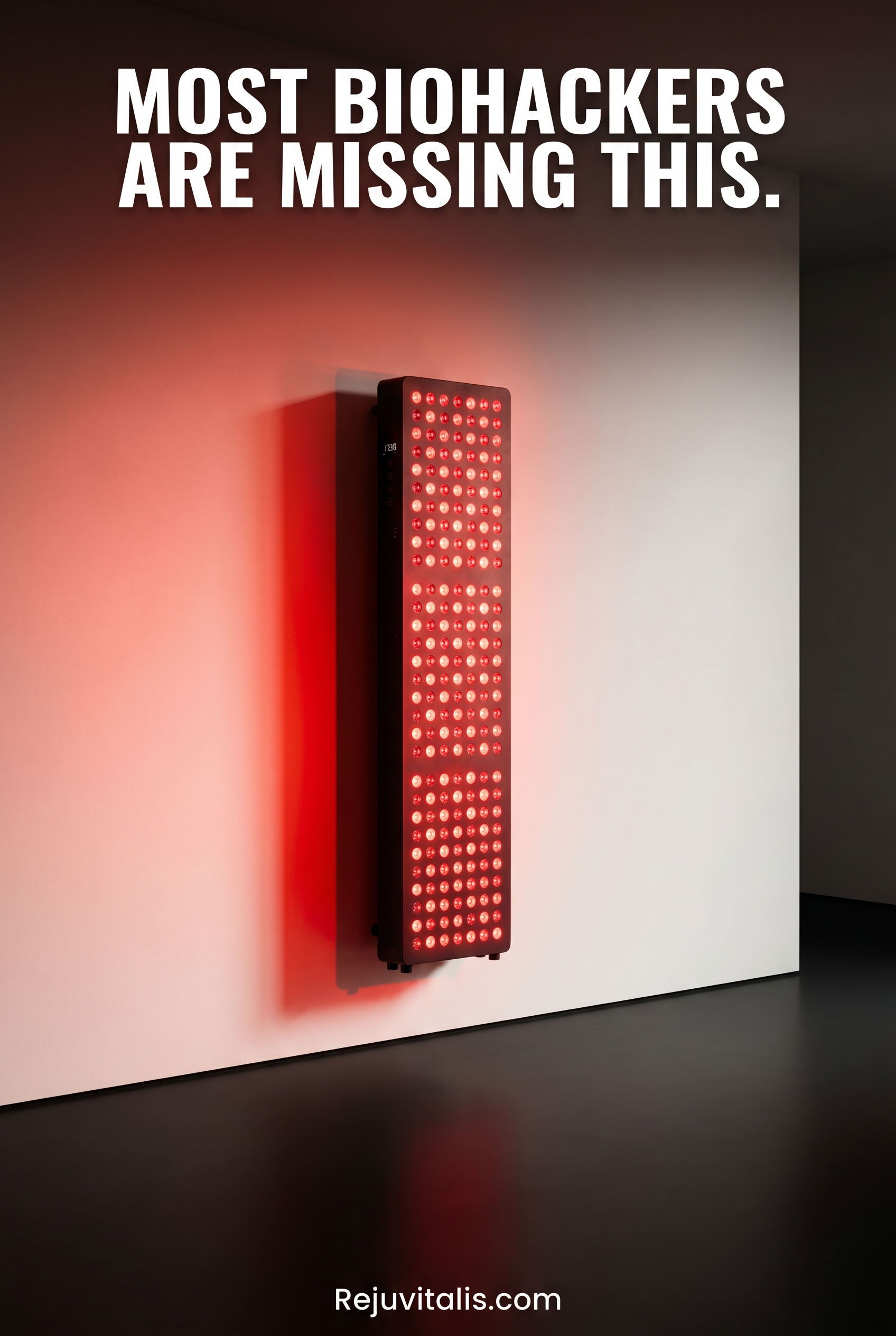
The RN300 is the red light therapy panel we carry at Rejuvitalis, and the one we recommend for buyers who want a serious home setup without navigating the complexity of building a custom multi-panel array.
Here's why it clears the bar on every spec that matters:
- Wavelengths: 660nm red and 850nm near-infrared — the two most widely referenced wavelengths in the category
- Output: verified light output at standard treatment distances, independently confirmed
- Coverage: full-body treatment area designed for efficient whole-body sessions
- EMF: near-zero at treatment distance — tested and published
- Build: aluminum housing, quality LED diodes rated for long-term daily use
- Warranty: backed by real support, not a disappeared dropship brand
It's not the cheapest option on the market. It's the option built to the specs that matter, made to last the years of daily use most owners are looking for.
→ Shop the RN300 Red Light Therapy Panel at Rejuvitalis
Frequently Asked Questions
How long does it take to notice a difference from using red light therapy?
Most people say the biggest early difference is simply how the session feels and how quickly it becomes part of their routine. Some people report noticing changes in how their skin looks or how a particular area feels after several weeks of consistent use, though individual experiences vary quite a bit. Consistency is what most regular users point to as the biggest factor.
Is red light therapy safe to use at home?
Millions of people use red light panels at home as part of a wellness routine, and it's a widely available consumer product category. That said, we're not able to make medical safety claims — if you have a specific health condition, are pregnant, or are unsure whether a red light panel is appropriate for you, check with your doctor before adding it to your routine. Avoid staring directly at an operating panel at close range.
Does red light therapy work through clothing?
Light needs a fairly direct path to reach the skin, so most people use their panel on bare skin for the fullest experience. Clothing will block or significantly reduce the light reaching the skin underneath. For sensitive areas or modesty preferences, thin, light-colored natural fabrics block less than heavy or dark fabrics, but skin exposure is generally preferred.
Can I use my panel every day?
Yes, daily use is common and is how most people build it into their routine. As with any wellness product, moderation and following the manufacturer's guidance is the sensible approach. If you have questions about frequency for your specific situation, your doctor is the best resource.
What's the difference between cheap panels and quality panels?
The primary differences are output accuracy (cheap panels often deliver a fraction of their advertised output), wavelength precision (low-cost LEDs may not hit the target wavelengths accurately), EMF output (cheaper driver electronics tend to produce higher EMF), build quality (affects longevity), and flicker (cheap power supplies produce visible flicker). A panel that underdelivers on output isn't a budget option — it's a less effective one, regardless of price.