

Infrared Sauna vs. Traditional Sauna: Which One Actually Works Better?
REJUVITALIS BLOG
Infrared Sauna vs. Traditional Sauna: Which One Actually Works Better?
Category: Infrared Saunas | Read time: 8–10 min | SEO target: "infrared sauna vs traditional sauna"
You've heard the buzz. Saunas are everywhere — biohackers swear by them, athletes recover in them, and wellness enthusiasts won't shut up about them. But if you're thinking about investing in one for your home, you're probably staring down a genuinely confusing question:
"What's the actual difference between infrared and traditional? And which one is worth my money?"
It's not just a matter of heat. These two technologies work on completely different principles — and depending on what you're after, one will serve you dramatically better than the other.
Let's break it down honestly, without the fluff.
First: How Does Each Type of Sauna Actually Work?
Traditional Sauna (Finnish / Steam)
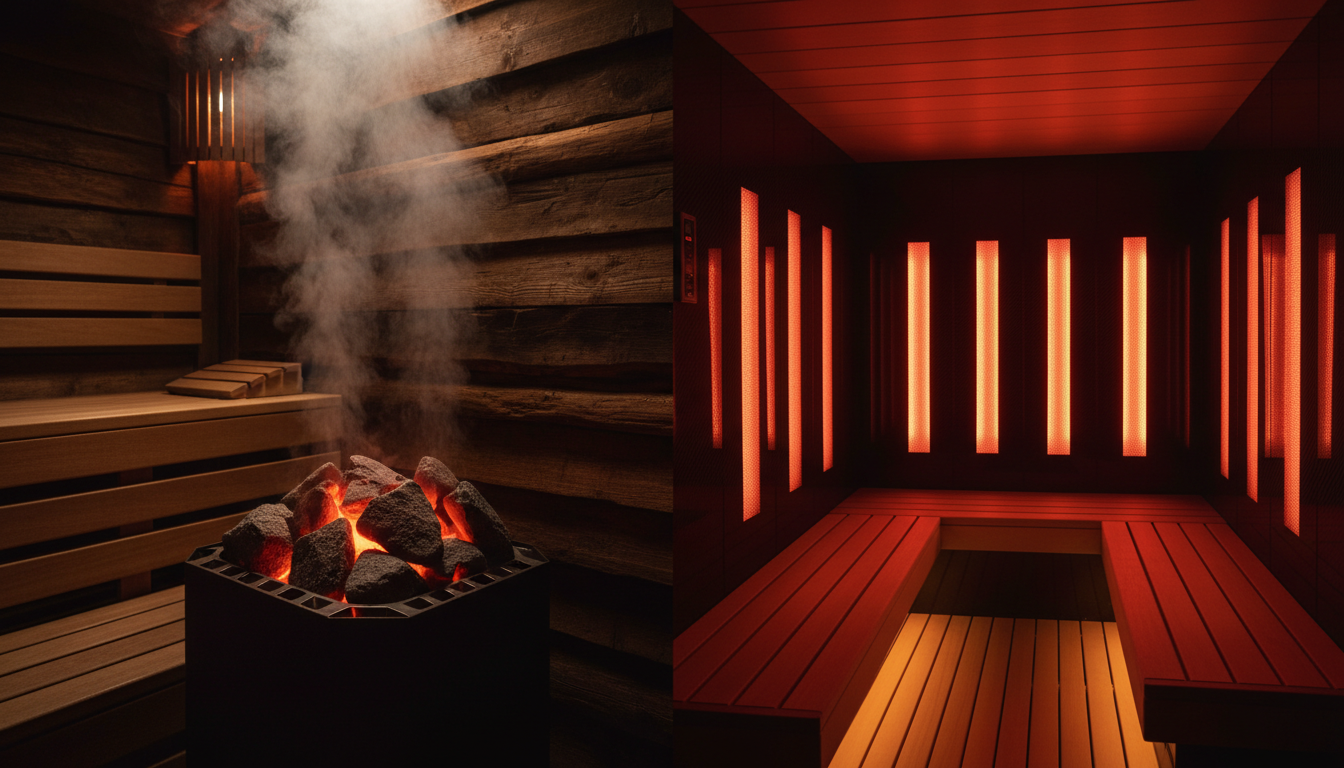
The original. Traditional saunas heat the air around you using a stove (either wood-burning or electric) that warms a pile of rocks to extreme temperatures. You then pour water over those rocks to create steam — raising the humidity and intensifying the heat.
Operating temperature: 160°F–210°F (71°C–99°C) | Humidity: 5–30% (higher with steam)
The intense heat raises your core body temperature rapidly through convection — the hot air transfers heat to your skin, which transfers it inward. Your body responds by dilating blood vessels and sweating as it works to cool itself down.
This is the classic model. Brutally hot, intensely humid when steamed, and deeply rooted in thousands of years of Scandinavian tradition.
Infrared Sauna
Infrared saunas skip the middleman. Instead of heating the air to extreme temperatures, they use infrared light panels to emit radiant heat that is absorbed directly by your body — reaching beneath the surface of your skin.
Operating temperature: 120°F–150°F (49°C–65°C) | Humidity: Very low (dry)
The air temperature is much lower, but your body absorbs the energy more efficiently. Think of the difference between standing outside on a cold winter day in the sun versus in the shade — same air temperature, very different feeling. That's infrared radiation at work.
There are three types of infrared: near, mid, and far. Far infrared (FIR) reaches deepest and is what most home infrared saunas use. Full-spectrum units combine all three.
What's Actually Happening to Your Body
Both saunas trigger a similar general response — but the intensity and depth of that response differ meaningfully.
Core Temperature Elevation
Both types raise your core body temperature. This triggers a cascade of responses: increased heart rate, sweating, and vasodilation — your body's normal ways of managing heat.
Traditional saunas get you there faster and more aggressively. Infrared takes longer to hit the same core temperature but does so at a lower ambient temperature, making it more tolerable for longer sessions.
Sweat Output
Here's where the arguments get heated (pun intended). Some proponents of infrared saunas describe a different quality of sweat because the heat penetrates tissue rather than just heating the surface, though how meaningful that difference is in practice varies by person, and it's not something we can make specific claims about.
Cardiovascular Response
Sauna heat causes your heart rate to rise, similar to how it responds during light to moderate physical activity — up to 100–150 BPM in a single session for some people. Both sauna types produce this effect, though the intensity is generally higher in traditional saunas.
Muscle Comfort After Activity
Infrared saunas have an edge here for many people. The penetrating warmth of far infrared light reaches beneath the skin, so many people feel it more directly in muscle tissue after a hard workout.
Traditional saunas rely on surface heating and general circulation, which is still a popular recovery ritual but feels different.
Head-to-Head: Infrared vs. Traditional Across Key Categories
Heat Tolerance & Accessibility
Traditional sauna: Intense. The scorching air temperatures can feel overwhelming for newcomers, people who are more heat-sensitive, or anyone who runs hot. Sessions are typically 10–20 minutes before you need to step out.
Infrared sauna: Approachable. The lower ambient temperature means most people can comfortably sit for 30–45 minutes. This matters because longer sessions mean more time to enjoy the experience.
Edge: Infrared — especially for beginners, older adults, or anyone with heat sensitivity.
Depth of Heat Penetration
Traditional sauna: Heats from the outside in. Surface skin temperature rises dramatically, driving core temperature up via conduction through tissue.
Infrared sauna: Reaches beneath the surface of soft tissue directly. This isn't marketing copy — infrared radiation in this wavelength range is absorbed by water molecules in human tissue.
Edge: Infrared for a deeper-feeling warmth. Traditional for raw heat intensity.
Muscle Recovery Routine
Traditional sauna: Popular with athletes post-training as part of a recovery ritual, thanks to the circulation boost from the heat.
Infrared sauna: Many people find it better suited for targeted muscle and joint comfort thanks to the direct tissue warmth.
Edge: Infrared, for many people's preference.
Stress Relief & Mental Wellbeing
Both are widely described as deeply relaxing — the kind of environment that naturally encourages you to slow down and unwind.
Traditional saunas have a cultural ritual element that many find uniquely grounding. The act of building the heat, adding steam, the sensory intensity — it's an experience. Infrared saunas are quieter, more meditative, more accessible daily.
Edge: Draw. Depends entirely on preference.
Skin-Focused Routine
Traditional sauna: Sweating opens pores, and the steam adds a hydration component that can be a nice part of a skin care routine.
Infrared sauna: The infrared wavelengths used in red and near-infrared panels are popular in dedicated skin-focused red light devices — the same general wavelength family. Many people incorporate infrared sessions into their skin care routine for this reason.
Edge: Infrared, particularly full-spectrum units with near-infrared.
Home Installation
Traditional sauna: Requires more space, proper ventilation (ideally a dedicated room), significant power draw (usually 240V), and either a wood source or high-draw electric element. Higher installation complexity.
Infrared sauna: Many plug-in models operate on standard 120V circuits. Portable and modular options exist. Lower operating temperatures mean less heat loss and lower energy costs. Much more practical for most home environments.
Edge: Infrared — significantly easier for home use.
Cost
Traditional sauna: Entry-level home units start around $3,000–$5,000. Custom built-in saunas can run $10,000+. Operating costs are higher due to greater energy consumption.
Infrared sauna: Quality home units range from $1,500–$4,000 for one- to two-person cabins. Energy costs are meaningfully lower. Better value per session for most users.
Edge: Infrared for value and total cost of ownership.
Who Should Choose What?
Choose an Infrared Sauna If You:
- Want to use it multiple times per week as part of a recovery or wellness routine
- Prefer a gentler heat experience, or are more sensitive to intense heat
- Are primarily looking for muscle and joint comfort as part of a recovery routine
- Want the easiest home installation with lower operating costs
- Are interested in a skin-focused routine alongside the other advantages
- Are new to sauna use and want to build a sustainable habit
Choose a Traditional Sauna If You:
- Love the ritual experience and the brutal intensity of real steam heat
- Have a dedicated space and the infrastructure for a permanent installation
- Want the closest thing to the authentic Finnish sauna experience
- Already have cold plunge access and want the classic hot-cold contrast experience
- Prefer shorter, more intense sessions over longer, gentler ones
The Honest Verdict
For most people considering a home sauna, infrared wins on practicality, versatility, and long-term usability.
The ability to install it without major renovations, run it on a standard outlet, comfortably sit for longer sessions, and enjoy a deeper-feeling warmth makes it the smarter choice for the overwhelming majority of wellness-focused buyers.
That doesn't mean traditional saunas are inferior — they're not. They're intense, time-tested, and deliver a uniquely powerful heat experience. But for the person building a home wellness setup focused on a daily recovery routine, relaxation, better sleep habits, and long-term consistency, the infrared sauna is the workhorse that will actually get used.
The best sauna is the one you'll use consistently. For most people, that's infrared.
What to Look for When Buying an Infrared Sauna
Not all infrared saunas are created equal. Here's what separates the serious units from the cheap ones:
Wood quality: Look for Canadian hemlock, basswood, or cedar. These woods tolerate repeated heat cycles without warping or off-gassing unwanted compounds.
Heater type: Carbon fiber heaters offer more even, full-body heat distribution compared to older ceramic rod heaters. Full-spectrum units combining near, mid, and far infrared offer the broadest experience.
EMF levels: Quality manufacturers test and publish low-EMF ratings. This matters if you're spending 30–45 minutes per session multiple times a week — ask for the specs.
Size: One-person units are compact and efficient. Two-person units give you room to lie down during longer sessions. Consider how you'll actually use it.
Certifications: ETL or UL listing confirms the unit has been independently safety-tested. Non-negotiable for a device you're running at home.
Ready to Experience Infrared?
At Rejuvitalis, we stock a carefully curated selection of infrared saunas built for serious home wellness — units that earn their place in your routine and don't disappoint after the novelty wears off. Every model in our lineup is selected for heater quality, wood integrity, EMF performance, and long-term reliability.
If you're ready to invest in your recovery routine, your relaxation, and your daily wellbeing — explore our infrared sauna collection and find the unit built for your space and your goals.
Frequently Asked Questions
Is infrared sauna safe to use every day?
For most healthy adults, yes. Daily sessions of 20–40 minutes at standard infrared temperatures (120°F–150°F) are generally well-tolerated. Stay hydrated, listen to your body, and consult a physician if you have cardiovascular conditions or are pregnant.
Can I get the same benefits from infrared as a gym sauna?
Gym saunas are typically traditional wet or dry saunas. You'll get a similar warm, relaxing heat experience from either, but the deeper tissue warmth, longer sessions, and skin-focused appeal are specific advantages some people associate with the infrared format.
How long does an infrared sauna session need to be to be enjoyable?
Most people find 20–45 minutes per session, 3–4 times per week, becomes a comfortable, sustainable routine. The lower temperature of infrared saunas makes these session lengths comfortable for most users — something that would be nearly impossible in a 200°F traditional sauna.
Does infrared sauna help with weight loss?
A sauna session does raise your heart rate and can burn some calories, similar to light physical activity, though the amount varies quite a bit by person. It's best thought of as a nice complement to an active lifestyle rather than a weight-loss strategy on its own.
What's the difference between far infrared and full-spectrum?
Far infrared (FIR) is the most common type in home saunas and reaches deepest into soft tissue. Full-spectrum units add near infrared (NIR) and mid infrared (MIR) wavelengths — NIR in particular is popular in skin-focused red light devices, and some full-spectrum sauna users appreciate that added wavelength range as a bonus.